The Shape of Meaning
What structure should meaning have? A grounded walk through the architecture, the philosophy behind it, and what it means for machine intelligence.
If you read one document, read this.
Read the white paper on GitHub →A semantic substrate for machine-to-machine communication. It turns unstructured inputs into grounded, inspectable claims and provides the stack of dialogue, governance, and constitutional layers that higher-level systems can build on.
The Symbol Grounding Framework (SGF) is a semantic substrate for machine-to-machine communication. It defines a shared, extendable lexicon in which terms carry disambiguated identifiers, a fixed hub-and-spoke grammar for representing events and claims, and a pipeline for compiling unstructured inputs into explicit, source-traceable meaning. New terms can be added dynamically as they are encountered.
On top of that substrate, SGF provides wire protocols for machine-to-machine dialogue, a typed governance layer for what systems may and may not do, and a constitutional layer for higher-order constraints. The result is a foundation on which governed AI systems, Knowledge Packs, federated organizational memory, and SGF-native operating systems can be built.
A Synapse is SGF's atom of meaning: a verb hub (an event or relation, identified by a Canonical ID) surrounded by a fixed inventory of typed semantic roles. Every clause in every language compiles to this same shape. The hub names what happened; the spokes name who, to whom, with what, where, when, why, and how.
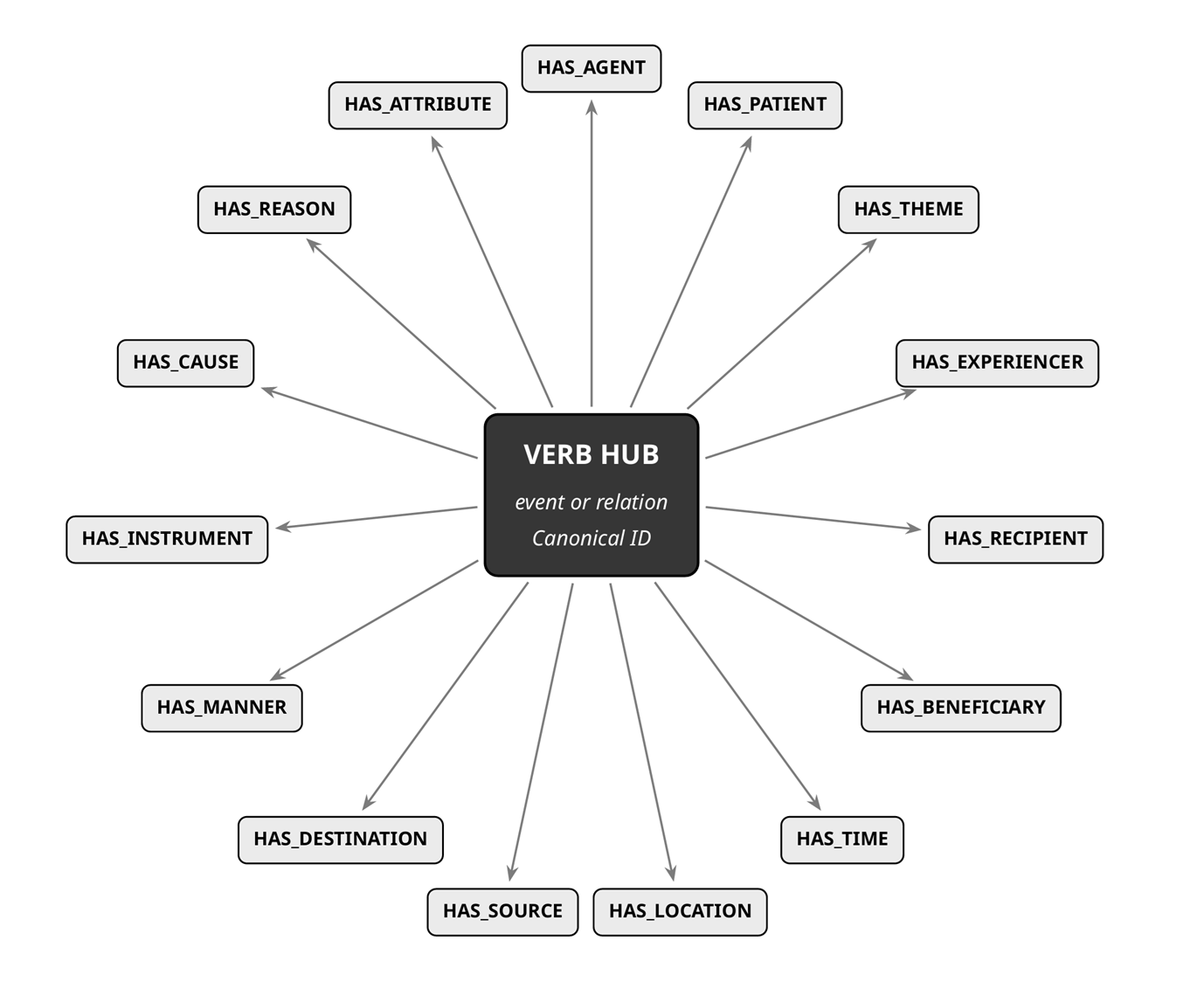
Atoms and molecules. Some claims are atomic and stand alone — Ludwig van Beethoven was born on 16 December 1770 is a single Synapse. But most real meaning is molecular: several atomic facts that only mean what they mean together. SGF provides SynapseGroups as the explicit grouping mechanism — a typed container that binds related Synapses into one composite claim, with its own group identifier and provenance. A clinical finding, a contract clause, a sensor event with its conditions and consequences — each is one molecule made of several atoms, addressable as a unit.
Today's models are fluent but fragile. They can speak, summarize, and imitate expertise — but they cannot prove what their words mean, where their claims came from, what rules bind their actions, how to share meaning with unfamiliar machines, or how to connect symbols back to physical consequence. SGF gives machines those five missing powers.
IS_A path down to irreducible semantic primes.None of the five survives alone. Grounding without verification gives stable words with no receipts. Verification without governance gives receipts with no law. Federation without grounding spreads ambiguity faster. Embodiment without the other four gives physical power to symbols that may not deserve it.
Six layers, bottom to top. Each layer is fixed at its core and extensible at its edges.
Machines can only share meaning when they share a format for meaning. SGF is engineered as an interlingua — a neutral middle language two machines can both compile into and read back from — by combining six pieces. Drop any one of them and the channel collapses back into prose.
language.lemma.microgloss.part-of-speech.namespace — for example en.bank.financial_institution.noun.core vs. en.bank.river_edge.noun.core. The microgloss bakes the sense into the address itself, so identifiers are disambiguated and reversible: any machine can unpack an ID and resolve it against the lexicon to recover the exact sense intended. No re-running disambiguation; no guessing which sense was meant.Put together: an English sentence and a Japanese sentence about the same event compile to Synapses with the same shape, the same role assignments, and Canonical IDs that resolve to the same lexicon entries in different languages. The two machines exchange meaning without translation as a separate step. That is what makes SGF an interlingua — and what makes machine-to-machine understanding an engineering problem with a solution, rather than a hope.
Free, open source, and extensible — the floor every layer above stands on.
The SGF Lexicon is an identifier-minting service for word meanings. Any organization can run it on its own hardware, against an open Wiktionary dump, with no API key, no cloud account, and no central authority to ask permission from.
en.bank.river_edge.noun.core. The ID is stable across runs, across machines, and across time. An LLM cannot do this: ask two different models to describe the same sense and you get two semantically-similar but textually-different paragraphs, unusable as database keys, foreign keys, or federation addresses. Only a canonical ID is.The substrate is only useful if prose can actually be compiled into it. GLEAN is that compiler.
A grammar, a lexicon, and a wire format are inert until something turns ordinary writing into grounded Synapses. GLEAN is a deterministic-first pipeline that reads English prose and emits a queryable Synapse graph — every claim anchored to Canonical IDs from the lexicon, every claim carrying its source span, its speaker, and its certainty.
author, character, orcitation — and an epistemic status —proven_fact, reported_claim, orspeculative. A downstream query for "what do we actually know about X" can filter onproven_fact and get only the claims the author personally asserts. Hedged language ("perhaps", "may have", "was likely") is flagged. Quoted attribution is preserved. Contested claims are not flattened into facts.speculative and direct quotes correctly attributed to the speaker rather than the author. Dates resolve to year-level literals you can pivot on (lit.year.1770) instead of disappearing into free-text strings.How grounded claims travel between machines, and how a receiver decides what to admit.
Once two machines share a grammar, a lexicon, and an identifier scheme, they still need a way to send claims and frame them correctly. HFF and AFP are that layer. HFF is the envelope; AFP is the speech-act tag that tells the receiver what kind of interaction is happening.
IS_A link back to a Core concept. The envelope is split into two blocks and processed in order: Block 1 hydrates the strangers, Block 2 contains the events. The receiver never has to guess at an unknown identifier — and is forbidden from helpful nearest-neighbor matching at the admission boundary.HAS_AGENT describes who plays a part inside an event. An AFP act describes what the sender is doing with the message itself. The same Synapse — a vehicle location update — can be wrapped as INFORM (sharing state), REQUEST (asking it be processed), or ACK (confirming a prior message). Routing on role fillers instead of act type is a category error that produces unsafe systems.REFUSE carries a typed reason code, names the failed gate, and gives the sender enough to retry, reroute, or escalate. Silent non-compliance is the catastrophic failure mode — the sender has no idea whether the message was rejected, lost, or quietly ignored. In a sovereign-receiver network, refusals are how the swarm learns local reality without a central brain.Machine-checkable rules for what a system may, must, and must not do — with the catastrophic moves made unrepresentable, not just discouraged.
Complex systems fail by closure: when the language you govern in is weaker than the substrate that executes, the failure class is exactly the set of behaviors you had no vocabulary to forbid. Prose constitutions, rules of engagement, alignment guidelines, and certification documents all share this wound. Omega is the missing grammar: a typed specification language in which permissions, prohibitions, powers, and obligations are first-class objects a machine can parse, type-check, and refuse against — before any action reaches the world.
CONSENSUS was proposed as a fourteenth primitive for multi-agent swarms, structural analysis showed it decomposed cleanly into existing primitives — a trust element identifying participants, a governance rule defining the threshold, a state transition recording the outcome, a learning axiom updating trust weights. It was not a new pattern, so it was not a new primitive. A grammar that can refuse its own feature creep on structural grounds has become a geometry, not a wishlist.Once SGF exists as a shared substrate, an ecosystem can form around it. Independent teams can publish Knowledge Packs: signed, versioned bundles of SGF facts, rules, event templates, and lexicon entries for domains such as the civil and criminal laws of a U.S. state, offshore-drilling regulations, clinical guidelines, accounting standards, or internal company policy. Any conforming system can install a pack without bespoke schema-mapping.
Because every pack is built on the same lexicon and event grammar, multiple SGF systems federate naturally. They exchange grounded claims over HFF and AFP, evaluate them under their own Omega rules and constitutions, and keep local sovereignty over what they admit, trust, and act on. The result is a marketplace of domain packs, compliance packs, and organizational memories — and SGF-native operating systems and agents that can share meaning while remaining governed and auditable.
A frontier language model can tell you, in full confidence, that a line from Gilbert and Sullivan is by Shakespeare. It can tell you Gene Wilder co-starred with Sean Connery in a film the two men never made. The cost of a wrong answer about Gilbert and Sullivan is a chuckle. The same architecture is being asked, today, to summarize patient histories and draft court filings. The cost stops being a chuckle.
The architecture has no internal mechanism to distinguish what it knows from what it has merely generated. A token in a statistical cloud has no address. Resemblance is mistaken for meaning. Systems built on resemblance cannot tell a fact from a fluent guess, cannot point at the source of a claim, and cannot decline an answer they were never given.
SGF replaces the cloud with a coordinate system. Every concept earns a canonical identifier with a finite path to an irreducible prime. Every assertion is a typed Synapse carrying its provenance. When the graph does not support an answer, the language returnsUNRESOLVED — a first-class verdict, not an embarrassment. Meaning becomes something a machine can check, transmit, and refuse.
The architecture is a hub-and-spoke graph. The verb sits at the hub. Fifteen semantic roles serve as the edge types. The endpoints carry canonical identifiers. The shared lexicon is the decompression map. Units combine the way clauses combine into sentences.
No single substrate can do every job. The architectural error of the moment is pretending one can. The fix is discipline: vectors at the gateway, symbols at the substance layer, LLMs at the rendering surface.
Vectors at the gateway decide what to look at next. Embed the user's question, retrieve candidate concepts. The vector layer never decides truth.
Symbols at the substance layer decide what is true, by whom, when, with what evidence. Every claim is discrete, attributable, auditable, reversible. The symbolic layer is the authority on what is true in the system.
LLMs at the rendering surface express the retrieved facts as prose a human wants to read. They receive a bundle of facts from the symbolic layer and transcribe them. They are forbidden, by architectural rule, to invent facts. If they have nothing to transcribe, they say so.
In a typical RAG-plus-LLM stack, the LLM is the final authority. In this composition, the symbolic substance layer is the authority. The LLM transcribes. Vectors route. The architectural rules are the difference between a system that hallucinates less and a system that cannot hallucinate by construction.
Today's frontier models try to be everything at once — language model, world model, knowledge base, search index, and reasoner — all compressed into one opaque pile of weights. That is why they hallucinate: the database has no schema, the facts have no addresses, and there is no way to edit, audit, or retract.
SGF separates the brain that routes from the world that is stored. The knowledge lives in the graph: every term has a Canonical ID, every claim is a Synapse with provenance, every rule is data. A small language model then acts as a Semantic CPU — a controller that issues typed hops over Synapses rather than guessing inside a token window. It does not contain the answer; it walks to the answer, leaving a trace.
The architectural consequences are concrete. Facts can be edited without retraining. Proofs can be audited because the traversal is the proof. The model stays small because it no longer has to memorize the world. And the same controller can be swapped — different brains, same substrate — because the substrate, not the weights, is where meaning lives.
One grounded event, one boundary-crossing act, one ill-formed claim that the receiver refuses to admit.
-- A grounded claim, expressed as a Synapse.
-- Canonical ID format: language.lemma.microgloss.part_of_speech[.namespace]
SYNAPSE deposit_event :
    VERB        en.deposit.place_funds.verb,
    AGENT       en.bank.financial_institution.noun.acme_holdings,
    PATIENT     en.account.demand_deposit.noun#A-91827,
    INSTRUMENT  en.wire_transfer.interbank_electronic.noun,
    AMOUNT      { value: 2500.00, currency: USD },
    TIME        2026-06-15T14:02:11Z,
    FRAME       frame.fact,
    PROVENANCE  { source: ledger.acme_holdings, signature: 0x9c1f… };

-- A request crossing a system boundary.
AFP_ACT REQUEST :
    SENDER      en.bank.financial_institution.noun.partner_trust,
    RECEIVER    en.bank.financial_institution.noun.acme_holdings,
    PAYLOAD     HFF_ENVELOPE( deposit_event ),
    EXPECTS     { ACCEPT | REFUSE };

-- Ill-formed: no PROVENANCE. The receiver does not admit it.
SYNAPSE rumor :
    VERB        en.claim.assert_without_evidence.verb,
    AGENT       en.entity.unspecified.noun,
    PATIENT     en.fact.unverified.noun;
-- error: SYNAPSE requires PROVENANCE before admission.
--        Envelope rejected at the boundary.
Canonical IDs supply reference. Synapses supply structure. Provenance and AFP acts supply the conditions under which a receiver accepts a claim.
Admission is checked at the boundary; transmission is not admission.
When two unbounded spaces need to be matched, the easy move is to find a measure of similarity and delegate the matching to it. The structure of the problem stays implicit. The matching is left to whatever embedding or distance function happens to be available.
The opposite move is to introduce explicit structure — a finite vocabulary, a named taxonomy, a controlled set of intermediates — and require both sides to be tagged with elements from that structure. The matching becomes a join through the structure. The design decisions live where they can be inspected, debugged, and revised.
Database design has known this since the relational model. Library science has known it since the Dewey Decimal System. Knowledge representation has known it since the first ontology. Each discipline learned, in its own time and at its own cost, that structured intermediates beat similarity matching when the corpora become large enough to matter.
SGF is the same principle applied to meaning itself. The fifteen semantic roles are a finite intermediate between unbounded events and unbounded participants. The canonical IDs are a finite intermediate between unbounded surface forms and unbounded senses. The 65 primes are a finite intermediate between unbounded vocabulary and the floor of grounded meaning. At every layer, the architecture replaces similarity with structure. The pattern recurs because the problem recurs: unbounded meaning, finite handles.
Answers are derived by walking a typed graph of grounded Synapses. Large language models translate at the edges — natural language in, natural language out — but the reasoning step itself is deterministic and replayable. Same query, same graph state, byte-identical answer. When the traversal fails, the result is UNRESOLVED.
The fifteen roles and the Synapse topology are fixed. Every participant maps its local vocabulary into the shared grammar once, and from then on speaks the same protocol to every counterpart. The integration cost across n systems stops being quadratic and becomes linear. I call this saving the Babel Tax.
The Prime Registry, the Canonical ID shape, the Synapse topology, and the fifteen roles are fixed. Extension happens through META_RULE under a validation protocol. An implementation that alters, removes, or reinterprets a core construct is not an SGF implementation.
For decades, a strain of philosophy of mind has argued that machine symbol grounding is impossible. A symbol can only be defined by another symbol. Defining one symbol requires defining the symbols you used to define it. The chain never terminates. Therefore symbols can never be truly grounded.
This is the infinite regress fallacy, a known logical error with a famous cousin in Zeno's paradox of Achilles and the Tortoise. The argument, taken seriously, proves that motion is impossible. We get on airplanes. The argument cannot be sound.
A tower does not need to reach the center of the earth. It needs bedrock. Working symbolic systems — mathematics, physics, law, code, ordinary language — do not wait for infinite proof. They define where explanation stops.
What grounding actually requires is much weaker. Mathematics terminates at axioms. Physics terminates at empirical postulates. SGF terminates at the 65 NSM primes — the irreducible concepts that the Natural Semantic Metalanguage research program found to be common to every human language studied. SOMEONE, SOMETHING, DO, HAPPEN, GOOD, BAD, THINK, FEEL, MOVE, TOUCH, BEFORE, AFTER, PLACE. Like prime numbers in mathematics, they cannot be decomposed further. They are the floor.
A canonical ID is grounded if a finite path exists from it, through IS_A and HAS_PART edges, down to one or more primes. If the path breaks or loops, the node is marked UNRESOLVED. The algorithm does not invent missing structure. The floor is finite. The decompression terminates. The chain does not go down forever.
If you are a knowledge-graph architect, audit your current project against the seven failure modes of landfill graphs: no canonical IDs, no instance minting, no derivation tags, no point-of-view tags, no coverage gate, no narrative sequence, embeddings as primary truth. If you find three or more, the architecture is telling you something.
If you are an AI engineer worried about hallucinations, build a small SGF graph from a corpus you know cold. Run GLEAN on it. Inspect the synapses. You will see what your current stack cannot: a graph where every claim points back to a byte offset in a source document, where contradictions sit side by side with provenance, where the reasoning engine can say "I do not know" and mean it.
If you are in robotics or autonomous systems, build a knowledge pack for your domain. Sign it. Distribute it. Watch a second system load it and reason from it without any integration work. This is the federation property of the substrate, and the only way to feel it is to do it.
If you are a researcher in symbol grounding, language, or knowledge representation, the lexicon is the open problem. The 1.7 million Wiktionary terms need to be processed into canonical IDs with microglosses, embeddings, IS_A chains, and HAS_PART relations. This is a project that wants many hands.
SGF is a substrate. Anyone can build an AI operating system on top of it. SGF OS is one such design — a worked example of what becomes possible once meaning, acts, and rules are grounded and inspectable. It is not the substrate, and the substrate does not depend on it.
SGF OS has two sides. The first is a small, stable kernel driven by prose rules and meta-rules — wisdom written in language a human can read, compiled into executable plans at runtime. The kernel does not self-modify; only the rule set and beliefs evolve. A probabilistic mind proposes; a deterministic kernel decides, acts, and records. This side is the subject ofThe Grounded Mind (Volume 4 of the SGF book series, below).
The second side is constitutional governance. An OS that must operate without continuous human supervision — a deep space probe is the thought experiment, but any environment where round-trip oversight is impractical qualifies — needs to pass new laws as its situation evolves, and needs a way to evaluate whether each new law is constitutional. The constitution is written in SGF, queryable, and binding on the hardware, not just on the policy document. A rule that cannot halt a motor is not a rule. This side is the subject of The Sovereign Machine (Volume 5 of the SGF book series, below).
The focus of this page remains the substrate — synapses, the HFF and AFP wire protocols, and the Omega governance language — because those are what other systems, including but not limited to SGF OS, are built from. But the OS layer matters: the central claim of The Sovereign Machine is that any high-stakes AI will need to look more like a governed mind with a stable kernel and a live constitution than like a single end-to-end model, if we want autonomy without ungovernability.
What structure should meaning have? A grounded walk through the architecture, the philosophy behind it, and what it means for machine intelligence.
If you read one document, read this.
Read the white paper on GitHub →The formal specifications are maintained as RFC-style documents in the specs directory: the Core Lexicon and Canonical IDs, the Synapse grammar and its fifteen roles, the HFF wire format, the AFP act protocol, and the Omega governance language. The repository is the source of record.
github.com/SymbolGroundingFramework/SGF-manifest/tree/main/specs
Six volumes covering the architecture, the philosophy, and the path to implementation. Each is available as a free downloadable PDF in the books directory and in print via Amazon.
github.com/SymbolGroundingFramework/SGF-manifest/tree/main/books
The entire framework — concepts, protocols, formats, grammars, and designs — is placed irrevocably in the public domain. No permission is required, no fee will ever be charged. I hold no patents on this architecture, none are pending, and I commit never to file any. There are no submarine patents waiting to surface. Reference code is released under Apache 2.0, which carries a built-in patent peace clause.
You do not need my code. The specifications are complete enough to build your own implementation in any language, describe the architecture in your own words, and build products without ever citing my work. Standards happen when many people build with them and no single person controls them. The web, the internet, and Linux all became universal because their creators chose adoption over ownership. I am making the same choice.
If anyone, including me, ever tries to capture this architecture, the community is invited to fork the specification. Take the public-domain blueprint and build your own consensus without asking my permission. The ultimate protection for any standard is the freedom to leave it.
Build something.
— James Lee Stäkelum